“Voces del lunfardo” Project Update

This week, we made significant progress on our project. I revised the start page to clarify for the user not only what “lunfardo” is, but also what they can expect when clicking on the available terms and how to navigate the site. I made the language of this section simpler, adapted for students of intermediate level. I explained that they could choose any term based on their personal interest since there is no specific order to follow. By doing so, they would be able to listen to tango songs that show the historical use of each term, along with more recent examples to see its evolution. And then I invited them to start the journey and try the activities.

Aaron added a link to our personal blogs with the idea of offering users more insight into the project’s development and the thought process behind our choices. This would allow users to understand more the ideas behind the decoration and the logo (what “filete porteño” is and the suggestions implied in the “Milonga” font).

I am currently adding more terms. Also, for all terms, I am adding a line that explains the most common use of each term in Argentina and an example of a common phrase that can be heard there. This should help users see the term in context. We also discussed the idea of incorporating audio, so that users can hear a native speaker pronounce the phrases in Spanish. This would enhance the learning experience and provide a more authentic touch.

Aaron is currently working on the slides for the presentation, and I will continue adding more terms to complete the list by the end of next week. Our goal is to have everything ready for the final stages of the project.
AI “Hallucinations” Project Update: Post-Break

Quick team update on where things stand since we got back from break.

Christian tracked down new links to digital archives focused on Puerto Rican histories. Finding sources that are both substantive and actually accessible is harder than it sounds, since a lot of digitized collections are fragmented or behind access walls. Having a solid list to work from is a real step forward for the prompt-writing phase.

Michelle has been working on two things. First, bringing in new design ideas for the website’s visual direction, and second, continuing to pursue outreach for project consultation. The design conversations in particular are starting to shape what the archive will actually feel like to someone encountering it for the first time.

A few bigger updates on the project overall. We’ve finalized our domain and are in the process of purchasing it and securing hosting, so the project will have a permanent home on the web soon.

We’re also scaling back the Puerto Rican history dataset. Given where we are in the semester, it’ll come in at roughly half the size of the BKED dataset. It’s the practical call, since a smaller, well-verified dataset is more useful than a larger one we don’t have time to fact-check thoroughly.

On the development side, we’re planning to add visualizations that compare hallucination patterns across both datasets. That’s the piece we’re looking forward to, since the comparative view is really where the project’s argument starts to become visible.

Coming up, we’ll also be putting together a first draft of the project slide deck, which will give us a chance to step back and think about how we’re telling the story of this project as a whole.

A Horrific Realization of The Impending End (…..of the semester)

These last few weeks during Spring Break, while it was helpful for many of us mentally to catch a break, it did slightly disrupt the rhythm of things. Despite that, our group continues to trek forward as the semester end begins to get ever closer. Last class meeting was helpful for us to rethink where we are within the scope of the project. We’ve made significant progress on various aspects of the project, things such as visualizations, website development, and, most recently, written content drafting.

The shape of the project is coming along, and we are managing to hit all of our key milestones. It’s interesting because I remember during the beginning months, I was having a hard time visualizing what exactly the final project would be, how it would come together. While the original shape and scope of the project changed during the development process, it still is great to see it coming together. However, in the end, we may need to revisit what our original methodology was and tweak a few things to match our current approach of the project.

During these next couple of weeks, our main focus is putting together the presentation, finalizing the website build and fleshing out the written pieces of content to be uploaded. We have a lot of small – medium things that need addressing within these upcoming final weeks that we will be working on. I think it is safe to say that all of us are excited to share our experiences at the end of the semester and show our project.

A Logo Is Worth a Thousand Words

One thing the break afforded me was the time to tinker around more with graphics, specifically in search of a logo. When I developed the header image and the other embellishments for the Voces del Lunfardo site, I stuck to tones of a single color to coordinate with the blue of the Argentinian flag. The header image is asymmetrical, while the horizontal rule embellishment is symmetrical. But in reading more about the filete porteño style, I saw that both vibrant color and symmetry were hallmarks. So I knew I had some work ahead of me to make something that was distinctively ours while getting as close as I could to the style.

I suppose I could have broken out my iPad painting and sketching apps, but I continued with Inkscape. The main reason is because it’s so much easier to build and combine simple and complex scalable vector graphics to make more complex shapes. So I started with the same basic image set I used for my header and started building.

My full Inkscape “scratchpad” is at the end of this post, but let’s walk through some details and the images I ended up putting on the site. First, I was playing around with stylized Ls and Vs, but didn’t want to end up replicating the Louis Vuitton logo, so I pretty quickly abandoned the V. I had some colors and letter decorations in mind, inspired by a very nice (and commensurately expensive) font set called Caminito. Its almost baroque stylings are achieved by layering the same letters atop one another with different fonts for each.

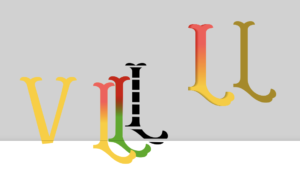
A "V" and several "L"s in different colors.

Rather than pay $125 on the full set of fonts, I decided to keep the font we had already been leveraging, confident I could replicate some of what I was seeing. Specifically what I wanted was to create a sense that the logo was a physical object, not just a digital one. That meant adding a bit of dimension, which you can see in one of the Ls above. Additionally, while creating the logos, I found that different scales afforded different component visibility, so I thought to have one small header image, one main page image, and one social media card image (theoretically!).

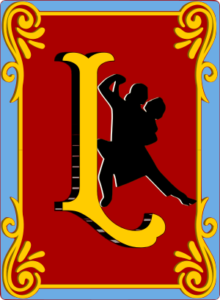
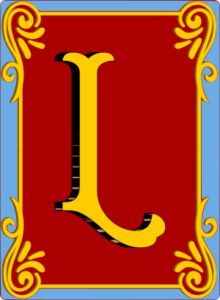
Voces del Lunfardo unadorned image - intended to be viewed at the smallest scale. It depicts a bright yellow L on a red background surrounded by a yellow/gold decorative frame and enclosed by a solid border in the same blue as on the Argentinian flag.


The smallest of the images is the above “unadorned” L. It’s what I put in the header of the site, so it’s visible on all the pages.

This is the main landing page logo intended for regular scale. It depicts a yellow/gold L on a field of dark red, framed in ornate yellow/gold and enclosed in a blue border. Next to the L is a silhouette of two tango dancers.


At the next scale we have the main landing page logo. The size of this image on the page allows us to continue to evoke the themes of Buenos Aires, and for this image we’ve chosen to add a silhouette of two tango dancers.

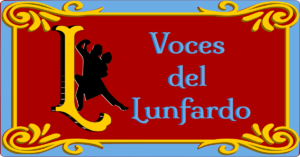
This is a version of the previous two logos, now turned on its side. It contains a bright yellow L, a silhouette of two tango dancers, and the words "Voces del Lunfardo" in blue text, all on a red field with an ornate yellow frame surrounded by a blue border.


The final image is scaled for use in social media cards. This is still a theory, though, as I have only one social network to test it on, and it only works intermittently. Since it’s made for sharing, it has the name of the site as well.

The resulting logos don’t run the gamut of possible color combinations one might see in filete porteño, I believe it successfully pays homage to its inspiration material. It does feel a little retro, too, making logos in this style, because these kinds of decorative elements aren’t as common on the Web as they used to be.

With more time, I could certainly improve these logos. As they are, however, I get the visual sense that they were pressed out on letterpresses, as engravings or linocuts perhaps.

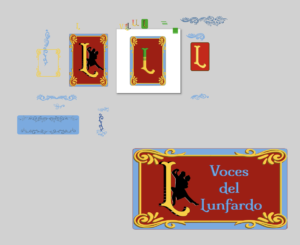
And finally, here’s that last look behind the digital easel at the growing clutter:

A mess of elements and logos in various states of experimentation and completion lie scattered across this screenshot of an Inkscape workspace.

The Birth of a Close Reading

Spring break is a lovely time to think about messed up body horror. So that’s exactly what I did.

While the planning stages of the project and website creation were fun in some ways, and it was interesting to see the broad trends across the games via data visualization, the in-depth analysis stemming from that feels to me like the real meat of the project. Or, to use a different metaphor, gathering the data as well as the theoretical texts was collecting the building materials, creating the website and data visualizations was laying the foundation, and now, writing the analyses and other text to pull the story of our project together is building the actual house. We needed those earlier steps to get here, but only now are we beginning to see how everything comes together.

We’re each doing an analysis of the theme overlap in one game to start- I did mine on motherhood and embodiment in Bloodborne. As part of this I made sure to pull in Barbara Creed’s monstrous feminine archetypes- particularly Archaic Mother and Monstrous Womb, both of which themselves link motherhood and embodiment via examination of birth and the fears it provokes. And Bloodborne is full of birth-related imagery and symbolism so it all comes together.

Of course “it all comes together” makes it sound so simple. It was not. The data visualizations we made pointed us toward theme co-occurrences to examine closer, but it was still up to us to find those themes and the way they overlap through a close reading of one particular game. The beginning of this search was honestly just a lot of thinking, going over the data visualizations, the academic grounding texts like Creed’s book, and the plot, gameplay, and imagery of Bloodborne. I sat on this for a few days, re-reading text from the game and some of the motherhood-related chapters from Creed’s book, and pasting quotes from both and fragments of thoughts in a messy planning document. Once I had enough to work with, I looked over it all and pinpointed a few particular mother figures in the game that most exemplified the themes, as well as noting that I’d also want to examine one of Bloodborne’s endings that puts the protagonist of the game – and by extension, the player – directly in the horror of both motherhood and embodiment, after they literally eat pieces of an umbilical cord and are physically transformed. (Bloodborne is such a normal game.) With these mother figure characters and this game ending in mind, I started writing. I knew from the start what I wanted to say in general, but refined my thoughts further as I wrote, as the process of writing exposing more connections between the themes, the game, and the theoretical frameworks.

When I reached the end, I went back through and tightened everything up, adding in additional context when needed, and removing some parts that the overall analysis drifted away from through the course of writing. And now… IT’S ALIVE!! This thing that started as a shambling mess of parts has – with a lot of thought and effort – come into its own as a whole written analysis. How terrifying!

“Hallucinations” Project Update

Individual and collaborative efforts within the past month have set everyone up to curate the data needed to fulfill core objectives while advancing the AI “Hallucinations” Project in other foundational ways. The website draft, presenting the BEKD as well as methodologies for constructing “hallucination” data, provides a base for designing an interactive, and appealing platform. Additionally, Michelle’s outreach form successfully enabled Sasha to begin finding initial audiences at Open Data Week. 

With these accomplishments in mind, we still have a few tasks to complete between today and the beginning of spring break. One of them is scheduling an appointment with a GCDI fellow, in which Michelle will soon find a time that is realistic for everyone, even if Spring Break permits. Lastly, I plan to assign Sasha and Michelle each to at least 2 of the digital libraries and databases already listed in the google doc. In doing so, each group member will have a set of digital locations to visit in order to begin conducting some research, which would be helpful with making ideas for prompts. The query prompts, as we have established, will inquire Puerto Rican histories, therefore some research ahead of time will benefit the overall pacing. In addition to post-Spring Break tasks, Michelle will finalize the website’s domain name. On that note, the project is in a solid position, where progress is certain after this point. The developmental successes made in this month have set the foundations for completing core objectives, such as writing up the prompts. Especially considering that I recently made guidelines for prompt engineering, it is further evidence that the AI “Hallucinations” Project has the tools and overall means to curate and share details of generative hallucinations to academia.

Project Update

The first phase of our work plan ended yesterday, March 26. During the first phase, the team met on Wednesdays in one-hour long Zoom meetings, as agreed. The group finalized the system selection and completed the compilation of terms, as planned. Aaron procured the domain and hosting, which later had to be moved to a cheaper plan, and he installed and configured the system, which leverages DokuWiki to provide robust and low compute content management. Aaron prepared a preliminary interface design, as planned.  He also managed to include some beautiful decorations in the style of “filete porteño” and also he included the colors of Argentinian flag and a beautiful font very appropriate for the site called Milonga. 

Natalia started to write the narrative of the first term “afanar”. We were supposed to have the narratives for all terms at this point (we  are behind in this respect). At the weekly Zoom meetings, the team discussed the progress on the interface and the narrative of the first term. The group also discussed how to add interactivity via DokuWiki plugins  for the quiz section. They also added explanations of some of the lunfardo terms included in the narrative section. This is very useful since it helps clarify the meaning of some difficult words that may appear. The group also started conducting initial outreach and contacted people that could spread the project among Spanish instructors and students. 

I think that the group met the expectations for this first phase. Even if the team should have by now all narratives already written, the compilation of examples and links has been finished, and I am sure that the group can complete both the narration of the commentaries and the entry of all the elements in the pages during the second phase (from today to April 16). This is the plan for the Spring break. In addition, Natalia will be designing the interactive activities for the remaining terms, while Aaron will be spending time drawing our logo, refining the design of the pages, and trying different forms of interactivity.  Overall, everything looks good; our goals have been fulfilled, even if the coming weeks will be fundamental to get closer to the completion of our project.

A not so terrifying update

Our project name finally came to us! We fell in love with A Pretty Terrifying Project, so we thought, why not just keep it? So our official project name is now…*drumroll* A Pretty Terrifying Project: Examining Feminist Theme Co-occurrences Across Horror Video Games. Ultimately, this was easy to come up with once we narrowed the scope of our project.

Everything seems to be on track, and we have a clear plan heading into spring break. The team has some smaller housekeeping things to take care of before spring break. Truly will be annotating some of the code in our current repo so I can navigate the existing code when working on it, and Michael will be updating some of the visualizations. In the next phase, we are focusing on website development, some close reading, and writing. I’m looking forward to working on the website during the break. I enjoy web development, so this is sort of a fun thing to do during my very uneventful spring break.

The team and I have each picked a game that falls into one of our key co-occurrences to do a close read during the spring break. Everyone’s pretty excited to work on these since we all chose areas and games we’re particularly interested in. Michael will be looking into Doki Doki Literature Club (girlhood + captivity), a cute, yet psychologically horrific game, while Truly will be working on Bloodborne (motherhood + violence), a dark, gothic, Lovecraftian-esque game. I, on the other hand, haven’t picked a game yet, but will focus on one that explores the co-occurrence of embodiment and violence. I’m interested to see how this collaborative writing experience pans out for us.

We’re trying to keep it light and enjoy the break, but we also took some time last night to plan ahead for after spring break and the final stretch! We’ve decided that ‘finished’ for us is a well-developed website that displays our visuals that holds important contextual analysis, such as related theoretical frameworks and close readings. We feel that this part may be the bulk of the work going forward, and we want to spend time ensuring we do thorough research and writing at this stage.

I think that the pretty terrifying team has a solid sense of what needs to be done to hit our upcoming milestones. Enjoy the spring break, everyone! Don’t work too hard!

Taking It Public

This week’s biggest milestone was presenting the Black Knowledge Erasure Dataset (BKED) at Open Data Week, and it’s honestly still sitting with me in the best way.

I was part of the CUNY x Open Data Week takeover at the NYC PIT Pop Up at the Oculus. Presenting alongside MindHeart AI and SPARK**CIVIC made for an interesting lineup, and the drop-in format meant we were talking to a genuinely mixed crowd: researchers, practitioners, curious passersby who had no idea what they were walking into.

What struck me most was how immediately the project clicked for most people. I expected to spend a lot of time explaining what AI hallucinations even are, but most people were already primed to be skeptical of these systems. What caught their attention was the framing — treating hallucinations not as glitches to be patched, but as data worth studying, as a window into whose histories these models were trained to center or ignore.

The feedback and questions I got were genuinely energizing. People were impressed by the project’s scope, curious about the methodology, and a few had insights that are actually going to stick with me as we move into the data collection phase of our new dataset. There’s something clarifying about explaining your work to people outside your immediate academic circle; it forces you to articulate the “so what” in a way that a classroom setting sometimes doesn’t.

It has me more excited about where this project is going than I’ve felt in a while. Getting that kind of external validation early is a good sign. Now we just have to make sure the finished product lives up to the pitch.